


Contents
- Executive Summary
- Part 1 – The Challenge: Transformation in a Complex System
- 1.1 Transformation and Complexity
- 1.2 Transformation as an Organisational Capability
- Part 2 – People and Safety at the Core
- 2.1 Safety as a Foundational Principle for Change
- 2.2 People-Centred Transformation
- 2.3 Engagement, Trust and Culture
- Part 3 – Orchestrating Transformation across the ATM System
- 3.1 Translating the Vision into ANSP Strategy
- 3.2 Evolving Governance for Transformation across Stakeholders
- 3.3 Delivering Transformation and Realising Operational Value
- 3.4 Cross-cutting Considerations for Future ATM Transformation
- Part 4 – What this Means in Practice
- 4.1 Treat Change Management as a Core Organisational Capability
- 4.2 Keep Safety Foundational and Manage the Safety of the Transition Itself
- 4.3 Put People at the Centre, and Co-design Change with Them
- 4.4 Build Trust and a Change-ready Culture
- Annex: Key Concepts and Definitions
- Acknowledgements
Overview
Executive Summary
This white paper is intended for leaders and practitioners across the global ATM community who are responsible for shaping, managing or delivering transformation. It responds to a specific and pressing challenge: the scale, pace and interdependence of change across ATM are increasing, placing growing demands on organisational capacity, governance and the workforce. It sets out a common framework for orchestrating that transformation safely, one that can be adapted to different operational, organisational and regional contexts.
- 01
Air Traffic Management is being transformed, and the question is whether the ATM community can orchestrate it safely, coherently and successfully.
Evolving operational demands, growing system interdependencies, workforce pressures and the accelerating introduction of digitalisation, automation and artificial intelligence are reshaping how services are delivered, how decisions are made and how people work together. This goes beyond another cycle of technological upgrades. It is a fundamental evolution of one of the world’s most complex and safety-critical socio-technical systems.
- 02
This work brings together the ATM community’s key institutions around a shared objective: to help the aviation community navigate transformation safely, collaboratively and with people at its centre.
This paper was convened by the Global ATC Alliance and CANSO, with the active participation of IFATCA, IFATSEA, IFAIMA, academia and independent experts.
- 03
Transformation can no longer be treated as a series of isolated projects, because in a system this interconnected, every change ripples.
Small technical or procedural changes can produce disproportionately large operational effects, with consequences surfacing in unexpected ways or places. Managing single initiatives well is not sufficient to assure success. The task now is to orchestrate many concurrent, interdependent changes across a living system that never stops operating.
- 04
The ability to orchestrate transformation is becoming a fundamental organisational capability for future ATM.
Organisations that develop this capability deliberately will be better equipped to evolve while maintaining safety, resilience and operational effectiveness. This requires clear governance, honest prioritisation and active management of interdependencies across multiple, concurrent changes. When treated solely as a support function or a collection of individual projects, change itself can become a source of strategic and operational vulnerability.
- 05
Safety is not the brake on transformation. It is the engine that gives us the confidence to move.
The old framing asked how to preserve safety while introducing change. That framing is too small. Safety must actively remain foundational and partner in the evolution, providing the confidence to innovate rather than merely guarding the gate, and it must keep evolving alongside the technology, organisations and people it protects.
- 06
The greatest risks of transformation can live in the journey rather than the destination.
Many changes overlap. For long periods, legacy and future systems will run side by side, with different procedures and varying levels of automation and maturity all in play at once. Managing the safety of the transition itself is therefore a central objective, rather than an afterthought once the target state is reached.
- 07
Automation shifts complexity and often hides it in new places.
New capabilities bring new pathways to failure, including hidden dependencies and emergent behaviours. That is why people remain the cornerstone of safe operation, exercising the judgement, contextual understanding and responsibility that cannot simply be delegated to technology alone. Technology should augment human performance while preserving human authority, accountability and informed judgement.
- 08
People are not simply the recipients of transformation. They must be active participants in shaping it.
Designing change together helps ensure that transformation is safe, trusted and grounded in operational reality. This requires those affected by change and relevant multidisciplinary expertise to be involved from the first design decision through to daily use. When learning and understanding fall behind the technology, that is a signal to slow down rather than a delay to overcome.
- 09
Transformation is complete only when it is safely adopted, routinely used and delivers its intended operational value, not when a capability is deployed.
Successful delivery must therefore be measured by outcomes rather than implementation milestones alone. Adoption, operational performance and benefits realisation are as important as technical deployment.
- 10
The greatest barriers to transformation are often cultural rather than technical, and trust is essential for change to be adopted and sustained.
Trust is earned throughout the lifecycle of change, through transparency about intent, risks and trade-offs, and through value demonstrated in practice rather than promised in principle. Culture determines how change is absorbed. Where it enables psychological safety and shared ownership, transformation takes hold. Where it does not, even technically sound solutions fail to be adopted or sustained.
- 11
This paper proposes a people-centred framework for orchestrating ATM transformation. It is not intended to prescribe one organisational model or a single pathway for every ANSP.
Each organisation must apply its principles according to its operational environment, institutional arrangements, workforce, maturity, investment capacity and strategic priorities.
- 12
Shaping the future skies is a shared responsibility.
The transformation ahead cannot be delivered by any organisation, profession or part of the aviation ecosystem acting alone. It requires us to work across traditional boundaries, learn together and take shared responsibility for how change is designed, introduced and sustained. The future of ATM will be shaped as much by how we transform as by what we transform.
Part 1
The Challenge: Transformation in a Complex System
1.1Transformation and Complexity
Air Traffic Management (ATM) is entering a new phase of evolution characterised by increasing operational complexity and growing system interdependencies, the rapid expansion of digital and data-driven ecosystems, the progressive integration of advanced automation, and the evolution of human roles in response to these changes. Together, these developments are creating new forms of interaction between people, systems, services, and organisations.
This interconnectedness can be seen even in apparently contained changes. An ANSP introduces a new automated conflict-detection tool at one facility. The technology may perform exactly as designed, yet its introduction changes more than the technical system. It can alter controller workload and vigilance, create new training and competency requirements, and raise questions about roles, authority and accountability when human and system judgement diverge. A seemingly contained technical change can therefore reshape roles, behaviours and interactions well beyond the technology itself.
ATM operates within an environment of exceptionally high safety and reliability expectations. Transformation must therefore take place while maintaining operational continuity, system integrity and stakeholder confidence. This creates an inherent tension between the need to innovate and evolve and the obligation to preserve safety and stability, particularly where the operational impacts and benefits of innovation remain uncertain.
In this context, transformation refers to sustained, interconnected change that materially affects how ATM is organised, operated and delivered. It may involve changes in technology, operational concepts, processes, roles, skills, governance and ways of working, often occurring concurrently and interacting across the wider ATM system. Transformation is therefore broader than the implementation of any single technology, project or initiative.
Changes introduced in one part of the system can generate consequences elsewhere that are difficult to anticipate. Small technical or procedural changes may produce disproportionately large operational effects, while system-level behaviours can emerge from interactions between multiple components rather than from any individual component in isolation. Legacy architectures continue to shape future options, while authority, expertise and decision-making are distributed across multiple organisations, disciplines and operational domains.
People and organisations are adaptive by nature. This adaptability is one of the great strengths of the ATM system and has been fundamental to the continuous improvement of safety, resilience and operational performance over many decades. During periods of change, people do not simply follow predefined processes; they respond, adapt, reinterpret and, where necessary, compensate for new systems and procedures in ways that may not always be anticipated. These adaptive responses occur across all levels of the system, from frontline operations to management, regulation and industry coordination.
For the workforce, this complexity can also be experienced as uncertainty: uncertainty about how roles will change, how automation will behave, whether existing expertise will remain valued, and whether the organisation is ready to manage the transition safely. What may appear as resistance can therefore provide an important signal that the implications of change are not yet sufficiently understood or trusted.
Continuous feedback from operational and technical staff to those responsible for designing, implementing and governing change is therefore essential. It should provide insight into how new technologies and ways of working influence operational pressures, human behaviour, workforce engagement and system performance, reinforcing beneficial adaptations while identifying and addressing unintended consequences. The interaction between technological change and human adaptation is itself a source of emergent system behaviour, particularly where it affects operational roles, professional identity and established ways of working.
These characteristics mean that change can no longer rely solely on technical implementation plans or traditional project management approaches. Instead, successful transformation requires organisations to develop the organisational capabilities needed to coordinate change across an increasingly complex and adaptive socio-technical system.
1.2Transformation as an Organisational Capability
Successfully navigating this environment requires organisations to develop the ability to orchestrate transformation deliberately, rather than treating change management as a supporting function. This capability encompasses leadership, governance, decision-making, organisational processes, competencies, communications and culture, enabling organisations to manage transformation in a structured, coordinated and adaptive manner.
This includes the organisational capability to:
- balance ambition with operational reality;
- maintain safety, stability and operational continuity throughout periods of transition;
- integrate technological evolution with changes in human roles, competencies and operational practices;
- sequence and pace change across interconnected domains with different rates of evolution, recognising that technological innovation often outpaces regulatory frameworks, organisational readiness and operational adaptation;
- manage cumulative change load and organisational absorption capacity, recognising that concurrent initiatives may compete for the same operational, training, engineering and leadership resources;
- sustain workforce trust, engagement and confidence throughout the transformation journey; and
- ensure that safety, security and operational effectiveness evolve together rather than independently.
Where it is weak, transformation risks becoming fragmented, reactive or overly technology-led. The cumulative effects of concurrent initiatives may then emerge as fatigue, reduced trust, implementation delays, operational workarounds or declining confidence in the change itself.
Ultimately, successful ATM transformation is not simply about introducing new technologies; it is about orchestrating a complex socio-technical journey that preserves safety, ensures operational continuity, strengthens organisational resilience and builds workforce confidence throughout the transition.
Part 2
People and Safety at the Core
2.1Safety as a Foundational Principle for Change
As ATM evolves, safety must evolve alongside technology, organisations and people, providing the confidence to innovate while maintaining public trust, operational resilience and the highest levels of safety performance.
ATM operates as a High Reliability Organisation (HRO) environment, characterised by an exceptionally low tolerance for failure, strong operational discipline, continuous monitoring and the ability to manage complexity under changing conditions. Preserving and strengthening these characteristics will remain essential throughout the transformation journey.
Transformation also introduces new forms of risk, particularly during the coexistence of legacy and future operating environments. (See Section 3.3.) Ensuring the safety of the transition itself therefore becomes a critical objective, requiring careful planning, validation, operational oversight and continuous organisational learning.
Safety concerns can also emerge when staff perceive that degraded modes, fallback procedures, failure behaviours, accountability boundaries or workload impacts have not been sufficiently understood. Such concerns should not be dismissed as resistance to change; they should be treated as safety intelligence and examined accordingly. This includes identifying and analysing weak signals and safety precursors before they develop into more significant events, enabling organisations to learn and act proactively.
Established safety practices, including compliance, standardisation, proactive hazard identification, risk mitigation and assurance, remain fundamental. Increasingly dynamic operating environments, however, also require stronger continuous system awareness, data-informed organisational learning, early identification of emerging risks and the ability to adapt as operational experience develops.
Safety as a Dynamic Organisational Capability
In increasingly complex operational environments, safety cannot be understood solely as a compliance objective or a static outcome. It is a dynamic organisational capability that enables organisations to anticipate, learn, adapt and continuously improve while maintaining operational performance.
A safe transformation therefore depends upon:
- continuous feedback between people, technology and organisations, enabling continuous learning and adaptation;
- transparent and responsible use of operational data, occurrence information, normal operations monitoring and operational experience to support informed decision-making and organisational learning;
- strong collaboration and shared situational awareness across stakeholders, supported by clear roles, responsibilities and governance arrangements; and
- recognition that uncertainty and variability are inherent characteristics of complex systems, requiring organisations to actively understand, manage and respond to them rather than assume them away.
Whilst automation and digitalisation have significant potential to enhance safety and operational performance, they may also introduce new pathways to failure, including unintended behaviours, hidden dependencies, non-linear interactions and emergent system effects.
Human roles therefore remain essential, particularly where judgement, contextual understanding, adaptability and decision-making under uncertainty are required. Safety depends on maintaining an effective balance between human and machine contributions, where each complements the strengths and compensates for the limitations of the other.
2.2People-Centred Transformation
People and Technology in Partnership
People-centred transformation requires systems, tools, procedures and operational concepts to be designed around human capabilities, limitations and needs, as well as operational reality and the way work is actually performed. Applying Human-Centred Design principles helps ensure that these considerations are addressed systematically throughout the transformation lifecycle.
Human Factors provides an important foundation for this approach and should be embedded throughout the transformation lifecycle, rather than considered as a separate activity or late-stage assessment. It helps organisations understand how changes in technology, procedures, roles and operating environments affect human performance and the performance of the wider system.
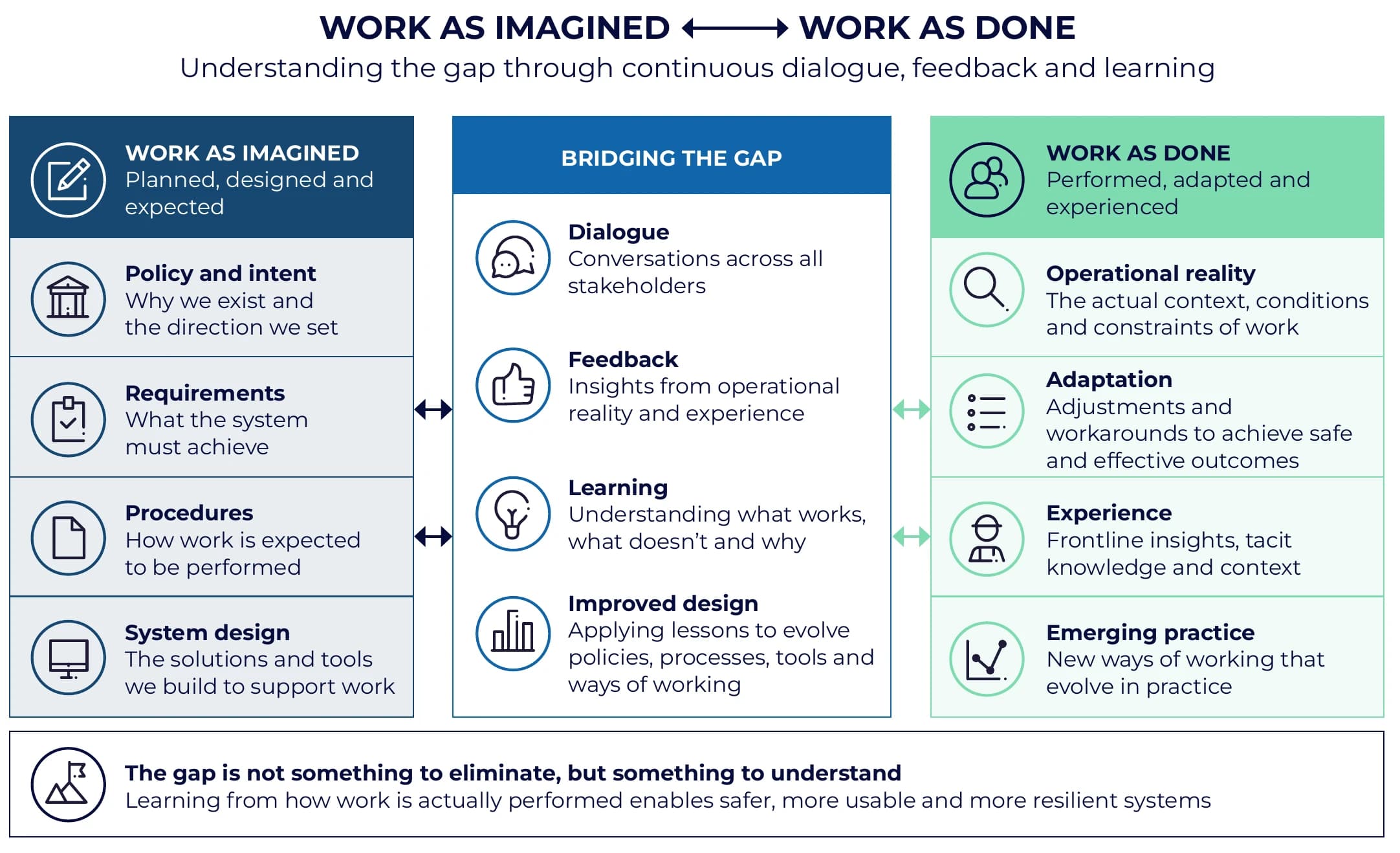
A persistent challenge in complex operational environments is the gap between work as imagined, how tasks and processes are assumed to function, and work as done, how they are actually performed under real operational conditions. Understanding this difference is essential when designing change. Operational experience can reveal practical constraints, adaptations and interdependencies that may not be visible from procedures, system specifications or organisational structures alone.
Figure 1 illustrates this relationship and the importance of bringing operational reality into the design and evolution of change.
As automation assumes an increasing share of operational functions, new dependencies emerge between people, technology and organisations. This makes the clear allocation of roles, responsibilities, authority and accountability increasingly important.
Organisations should ensure clarity regarding:
- the allocation of responsibility and accountability between people and automated systems;
- the circumstances under which human intervention is expected or required; and
- the boundaries within which system behaviour is understood, predictable and operationally acceptable.
Operators also need the right information, at the right time and in the right form, supporting effective decision-making without creating cognitive overload, disengagement or unnecessary constraints on human performance.
Co-Design and Multidisciplinary Collaboration
People-centred transformation therefore depends on the early and sustained involvement of those affected by change and relevant multidisciplinary expertise throughout system design, testing, implementation and operational use. Co-design provides a structured way of bringing these perspectives together, enabling assumptions to be tested early, potential problems to be identified before they become embedded, and solutions to be shaped around both operational needs and system objectives.
This does not mean that every stakeholder participates in every decision, nor that co-design replaces clear accountability. Rather, the people and expertise relevant to a particular change should have meaningful opportunities to influence it at the stages where their knowledge and experience can add value.
Multidisciplinary collaboration is particularly important as ATM systems become more digital, automated and interconnected. Operational, technical, safety, Human Factors, training, regulatory, cyber, data and organisational perspectives increasingly need to be considered together rather than sequentially. This helps organisations anticipate interactions and unintended consequences that may otherwise emerge only during implementation or operational use.
Organisational Readiness and Capacity to Absorb Change
People-centred transformation also requires attention to organisational readiness and the capacity to absorb change. Even well-designed capabilities can create difficulties when multiple initiatives compete for the same people, training capacity, operational attention or specialist expertise. The pace and sequencing of transformation should therefore take account of the organisation’s ability to learn, adapt and maintain safe operations while change is underway. This includes considering the effects of cumulative change on operational capacity, training, fatigue and workforce wellbeing, particularly where several changes are competing for the same people and organisational resources.
This requires sustained investment in learning and competence, including scenario-driven training and the development of capabilities such as systems thinking, data interpretation, automation management and cross-domain coordination. Early involvement of training specialists helps ensure that learning programmes can be designed, scheduled and integrated with operational priorities from the outset.
Learning and feedback should continue throughout implementation and operational use. Experience from frontline operations, testing, training and early deployment should be used to challenge assumptions and adapt systems, procedures and implementation approaches where necessary.
2.3Engagement, Trust and Culture
Engagement, trust and culture are essential organisational capabilities for managing complexity, enabling adaptation and sustaining safe system evolution.
Engagement and Organisational Alignment
Organisational engagement plays a decisive role in shaping how transformation is experienced, understood and sustained. While strategies, technologies and governance may define the direction of change, transformation ultimately succeeds or fails at the operational level, where people and teams adopt new ways of working under real operational conditions.
Effective engagement requires:
- psychological safety, enabling individuals to question, learn, contribute and raise concerns;
- shared responsibility and structured co-design, fostering ownership of outcomes;
- continuous feedback mechanisms with visible organisational responsiveness; and
- organisational structures, governance and processes that reinforce collaboration, learning and multidisciplinary engagement.
Strong and inclusive governance should provide the structures through which concerns can be surfaced, competing perspectives examined and difficult issues worked through rather than avoided.
Alignment between strategic vision and operational reality is essential to successful transformation. Disconnects between high-level transformation strategies and day-to-day operational experience erode trust, weaken engagement and slow the adoption of change.
Trust as the Foundation for Successful Transformation
Trust is a critical condition for successful transformation. It reflects confidence in the purpose of the change, the way it is being managed, the people and institutions responsible for it, and the systems being introduced. Without trust, even technically sound solutions may fail to be adopted or effectively used over time.
Trust is built through:
- clarity of purpose and shared understanding of desired outcomes;
- transparency about intent, decisions, risks and trade-offs;
- a transformation journey with clear direction, phases and milestones;
- early and continuous involvement of relevant expertise through structured co-design and collaborative decision-making; and
- demonstrated value through meaningful engagement and tangible operational outcomes.
Trust in people and organisations, and trust in technology, are related but develop in different ways. Interpersonal and organisational trust is shaped by behaviours, relationships, competence, transparency and experience. Trust in automation develops through demonstrated reliability, predictability and an appropriate understanding of system capabilities and limitations. The objective is therefore not simply to maximise trust, but to ensure that it is appropriately calibrated: both insufficient trust and misplaced or excessive trust can undermine safe and effective human-machine performance.
Automation and digital tools should therefore be reliable and consistent, sufficiently explainable for their operational context, transparent regarding their limitations and failure modes, and aligned with human roles, responsibilities and operational realities.
Importantly, trust is shaped not only by actual system performance and organisational arrangements, but also by how individuals and teams experience the transformation journey.
Managing both real and perceived risks is therefore important to successful adoption and sustained operational confidence.
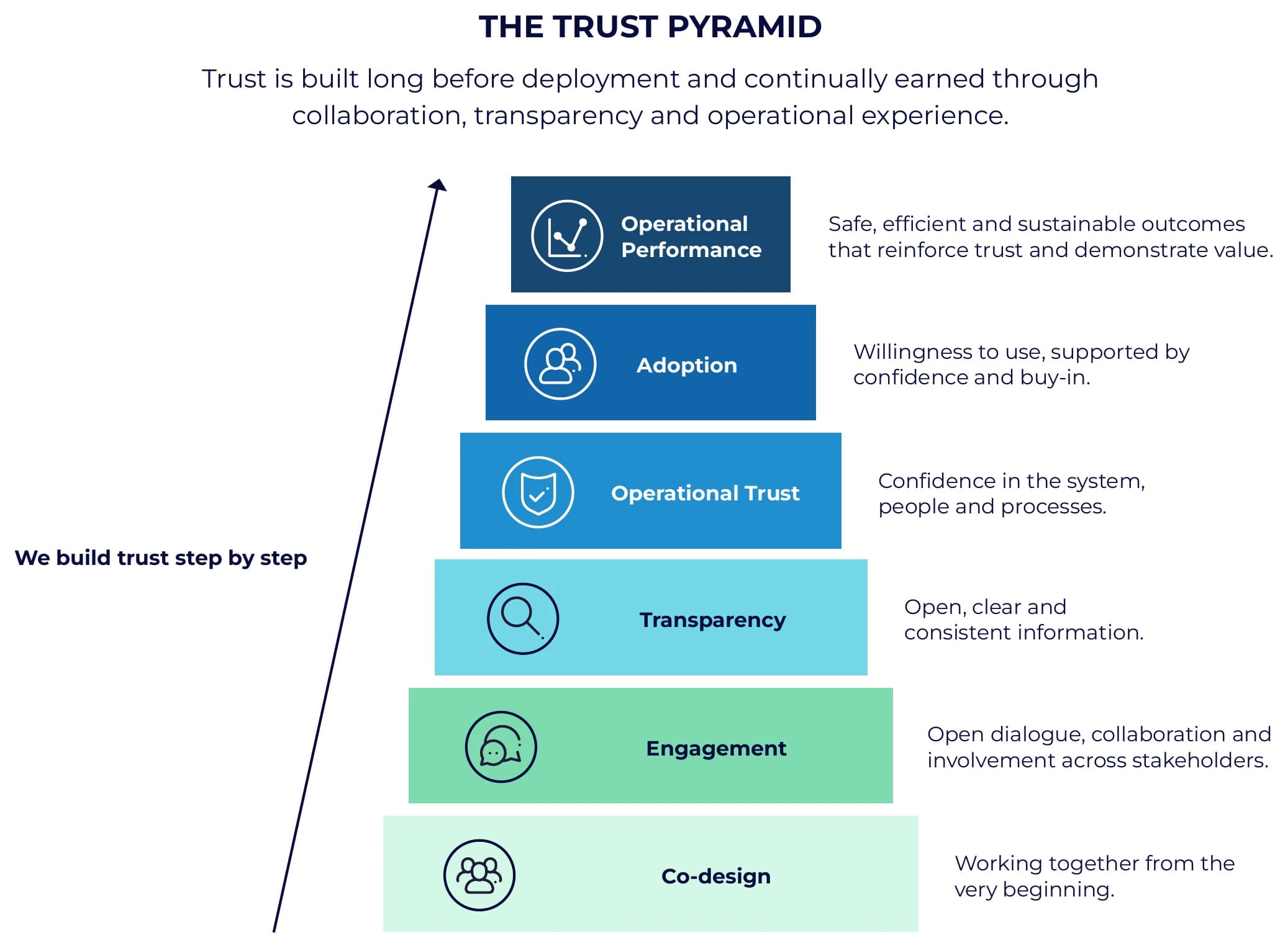
Figure 2 illustrates how trust develops progressively through transparency, engagement, co-design and operational experience, reinforcing successful adoption and operational performance.
Organisational Culture as the Engine of Transformation
Organisational culture underlies many of the challenges encountered during transformation. Resistance to change, lack of trust, communication failures and implementation difficulties may reflect cultural barriers rather than technical shortcomings.
Sustainable transformation depends on an organisational culture that enables trust, learning, collaboration, engagement, shared ownership of change and collective accountability across the organisation.
As transformation accelerates and expertise becomes increasingly distributed, a strong and consistent organisational culture becomes even more important. No single function, discipline or organisation can successfully manage transformation in isolation. A shared culture provides the cohesion that enables diverse expertise to work effectively towards common objectives, including when perspectives, priorities and interests differ.
Understanding Resistance as Operational Intelligence
In safety-critical environments, resistance should not automatically be interpreted as opposition to progress. It may signal unresolved safety concerns, unclear accountability, insufficient readiness, workload pressures, lack of trust or change fatigue. It may also indicate that operational realities or the implications of change are not yet sufficiently understood.
Treated constructively, resistance can become valuable operational intelligence: insight drawn from experience and day-to-day practice that helps organisations understand how change is actually working in the operational environment. It can help organisations identify where confidence is missing, where assumptions need to be tested, and where the pace, design or implementation of transformation may need to adapt.
Part 3
Orchestrating Transformation across the ATM System
ATM transformation must bring together strategy, governance and delivery while multiple changes unfold simultaneously across organisations, operational environments and stakeholder boundaries. The challenge is to maintain a clear direction while managing interdependencies, competing priorities, different levels of readiness and the realities of continuous service delivery.
This is where transformation moves from ambition to execution. This section explores the organisational capabilities needed to translate strategic intent into coordinated action, govern transformation across stakeholders and turn change into sustained operational value.
3.1Translating the Vision into ANSP Strategy
While global visions such as the Complete Air Traffic System (CATS) Concept of Operations (CONOPS) for Future Skies provide strategic direction, each ANSP operates within its own evolving operational context, institutional environment, regulatory framework, investment capability, workforce realities and strategic priorities. Transformation therefore requires the long-term vision to be translated into an organisation-specific strategy that is both achievable and adaptable over time.
This begins with understanding the gap between current operational reality and the desired future state. Defining the destination is not enough. Equal attention must be given to the transition states between the current and future operating environments. Some changes may occur through clearly defined moments of implementation or upgrade; others will emerge through gradual operational, technological and organisational evolution.
These transition states may be prolonged and complex. Different parts of the organisation may also progress at different speeds (see Section 3.3). Strategy must therefore address not only what the future system should become, but how safe, resilient and continuous service provision will be maintained throughout the journey.
Transformation also unfolds within significant constraints. Funding and investment cycles, regulatory approval processes, national capabilities, legacy infrastructures, contractual commitments, workforce capacity, training requirements and technology lifecycles can all influence the pace, sequencing and scope of change. At the same time, operational demand, external conditions and strategic priorities may evolve in ways not anticipated when the strategy was developed. These realities should not be treated merely as barriers to implementation; they must actively shape practical, achievable and sustainable transformation pathways.
Long-term transformation strategies must therefore combine continuity of purpose with adaptability in execution. The intended outcomes should remain sufficiently stable to guide investment and collective action, while implementation pathways should be periodically reassessed as operational experience is gained, assumptions are tested and technologies evolve. For major programmes with long implementation horizons, this may include deliberate decision points at which scope, sequencing or continuation can be reconsidered before further commitments are made.
From Delivering Individual Changes to Orchestrating Transformation
This requires moving beyond isolated, project-based thinking towards a system-level approach in which priorities are clearly defined, interdependencies are actively managed, and strategic trade-offs are made explicit. Without such coordination, organisations risk fragmentation, duplication of effort and unintended operational consequences.
Individual initiatives interact, and their cumulative effects may amplify both benefits and risks. A programme that appears manageable in isolation may create significant operational, technical or human pressures when combined with other concurrent changes. This wider view is particularly important where several initiatives compete for the same operational, engineering, training and leadership capacity. The organisation’s ability to absorb change must therefore influence not only how transformation is delivered, but also what is prioritised, when it is introduced and at what pace.
Transformation is ultimately realised within operational units, engineering and technical departments, training organisations and frontline working environments. Operational supervisors, watch managers, training managers, engineering leaders and local management play a critical role in translating strategic intent into operational reality while maintaining safe and continuous service provision. Their experience provides essential feedback on organisational readiness, implementation pressures, emerging risks and the practical effects of change, and should inform the continuing evolution of the transformation strategy.
Understanding whether transformation is progressing successfully requires more than tracking delivery milestones, implementation dates or technical deployment. Performance evidence should be considered alongside operational experience and workforce insight to understand whether change is producing the intended safety, operational, organisational and human outcomes, including its effects on operational continuity, human performance and workload, workforce readiness and engagement, usability, adoption, trust and the organisation’s capacity to absorb further change.
Where appropriate, organisations should also use leading indicators to understand cumulative change load and emerging constraints on their capacity to absorb further change. These may include, for example, the capacity of the organisation to deliver required training, the availability of operational staff to support implementation and transition activities, and the number of concurrent changes affecting the same teams or operational areas. Such indicators can provide early warning that the pace or combination of change may be exceeding organisational capacity.
This requires transformation orchestration capabilities that enable organisations to:
- prioritise and sequence transformation initiatives;
- coordinate deployments and manage transition states over time;
- understand the cumulative impact of concurrent changes;
- manage interdependencies across programmes, operational domains and organisational boundaries;
- align strategic objectives with operational realities, workforce readiness, training capacity and investment planning;
- maintain visibility of trade-offs, constraints and emerging risks; and
- embed organisational learning, continuous adaptation and evidence-informed decision-making.
3.2Evolving Governance for Transformation across Stakeholders
Transformation in ATM occurs across highly interconnected operational, technical, safety, training, regulatory, institutional and commercial environments. Authority, expertise and accountability are distributed across organisations, disciplines and levels of decision-making. No single function or stakeholder has all the knowledge, authority or perspective required to manage transformation successfully. Effective governance must therefore connect these different perspectives while maintaining clear accountability for decisions and outcomes.
Governance provides the structures and processes through which strategic intent is translated into collective decisions and coordinated action. It defines roles, responsibilities, authority and accountability, supported by clear and repeatable processes for decision-making, communication, assurance, escalation and feedback. These arrangements should be documented, clearly understood and periodically reviewed as the transformation and its surrounding environment evolve.
Good governance connects strategic authority with operational reality. It establishes who has the authority to decide, who must contribute, who is accountable for outcomes, how competing priorities and risks are resolved, and how operational experience feeds back into future decisions. It must connect strategic leadership with those responsible for operations, design, engineering, safety, training and implementation. Without these connections, governance risks becoming either too distant from operational reality or too fragmented to maintain system-wide coherence. Leadership transitions also require attention, as continuity of strategic direction, commitment and communication can be critical to sustaining trust and transformation momentum.
From Consultation to Co-Design and Shared Accountability
As established in Part 2, people-centred transformation requires meaningful involvement throughout the transformation lifecycle.
Governance should therefore define who needs to contribute, at what stages, with what authority, and how different forms of expertise are reflected in decision-making. Co-design does not dilute accountability: decision rights and responsibility for outcomes must remain clear, while relevant multidisciplinary expertise has meaningful influence before decisions become difficult or costly to reverse.
As expertise becomes increasingly specialised and distributed across operational, technical, safety, regulatory, training, cyber, data, automation and organisational domains, governance must create the conditions for these perspectives to come together, assumptions to be challenged, conflicting perspectives to be examined and collective intelligence to inform decision-making.
Governance is most valuable when perspectives diverge. It should provide trusted mechanisms for conflicting priorities, risks and perspectives to be surfaced, examined and resolved, supported by psychological safety that enables participants to question assumptions, raise concerns and communicate emerging risks. Equally important, organisations should make visible how concerns and recommendations are assessed and acted upon; otherwise, engagement risks becoming symbolic and trust can be weakened rather than strengthened.
Transformation governance and coordination mechanisms should therefore support:
- early and continuous involvement across organisational levels and stakeholder groups;
- formal participation of the operational workforce and appropriate standing of its recognised representative bodies within governance arrangements;
- clear allocation of roles, decision rights, responsibilities, authority and accountability;
- transparent decision-making structures, criteria and escalation pathways;
- multidisciplinary forums connecting strategic, operational, technical, safety, training and workforce perspectives;
- mechanisms for coordinating interdependencies, resolving conflicts and making trade-offs explicit;
- accessible reporting and feedback channels, with visible organisational responses;
- independent challenge and periodic review of major assumptions and decisions; and
- protection of rights, including just culture principles, psychological safety and appropriate whistleblower safeguards.
These considerations should also be embedded in procurement and contracting decisions, ensuring that operational, human and organisational needs shape new capabilities from the outset, rather than being addressed only after technical solutions have been defined.
Where recognised workforce or professional representative bodies exist, their involvement should form a standing part of transformation governance rather than having to be renegotiated for each individual initiative. Their role, like that of other governance participants, should be sufficiently clear to enable meaningful contribution rather than participation in observer status alone.
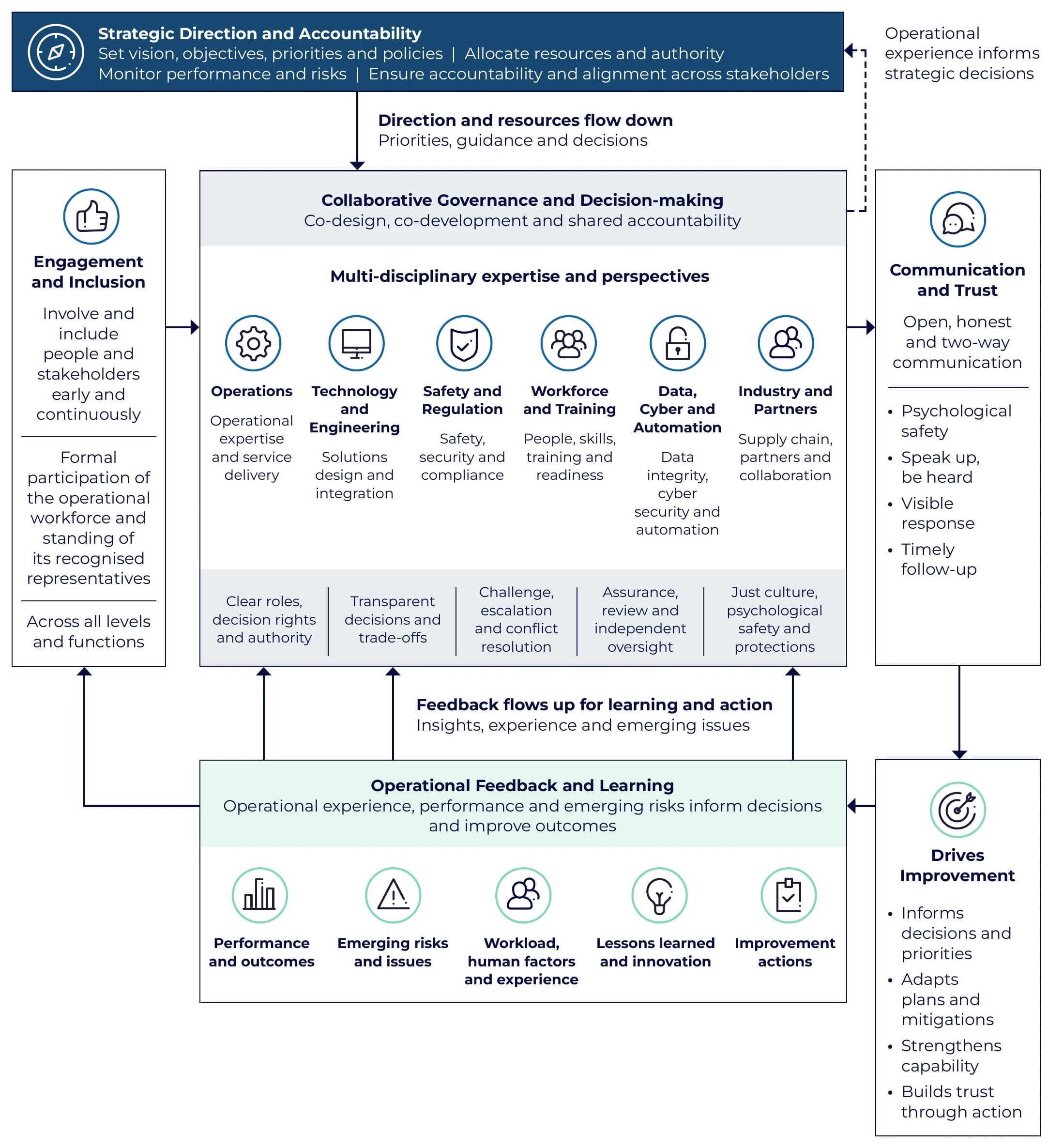
Governance arrangements will differ between organisations. Figure 3 illustrates the essential governance relationship: strategic direction flows towards implementation, while operational experience, emerging risks and learning flow back into decision-making. It is a conceptual model rather than a prescribed organisational structure.
Governance also operates across multiple interconnected layers:
- global, including ICAO frameworks, standards and guidance;
- regional, including coordination mechanisms, implementation programmes and collaborative initiatives;
- national, including regulatory, policy, financial and institutional arrangements;
- organisational, including ANSP leadership, workforce structures, operational units and internal decision-making processes; and
- local and operational, where transformation is implemented, experienced and adapted in practice.
These layers operate within different regulatory and labour frameworks, financial and governance models, institutional arrangements, levels of organisational maturity and cultural contexts. Effective governance must recognise these differences while maintaining sufficient alignment to support interoperability and coordinated system evolution.
Governance must also provide credible routes for those closest to implementation and operations to identify cumulative pressures and escalate when the organisation’s capacity to absorb change is being approached or exceeded.
In a high-reliability environment such as ATM, safety remains foundational to all transformation decisions. Safety governance should not, however, operate only as a final approval gate. It should contribute throughout the lifecycle of change, enabling early identification of emerging risks, informed experimentation, continuous assurance and adaptation as operational experience is gained.
Effective governance does not remove uncertainty, disagreement or competing interests. It ensures that they cannot simply be avoided. It creates the conditions in which difficult issues are surfaced, different forms of expertise are respected, decisions remain connected to operational reality and feedback can change the course of transformation when the evidence requires it.
Transformation governance should therefore do more than control individual changes. It is part of the organisational infrastructure for transformation itself: connecting strategic authority with distributed expertise, maintaining accountability and enabling safe operational evolution. Crucially, strong governance must sustain collaboration not only when interests align, but when priorities conflict, uncertainty is high and difficult decisions must be made.
3.3Delivering Transformation and Realising Operational Value
This distinction is particularly important in ATM, where technically successful deployment may still be followed by a prolonged period of adaptation. New capabilities must be incorporated into established operational environments, procedures and behaviours while maintaining safety and continuity of service.
The Value Gap
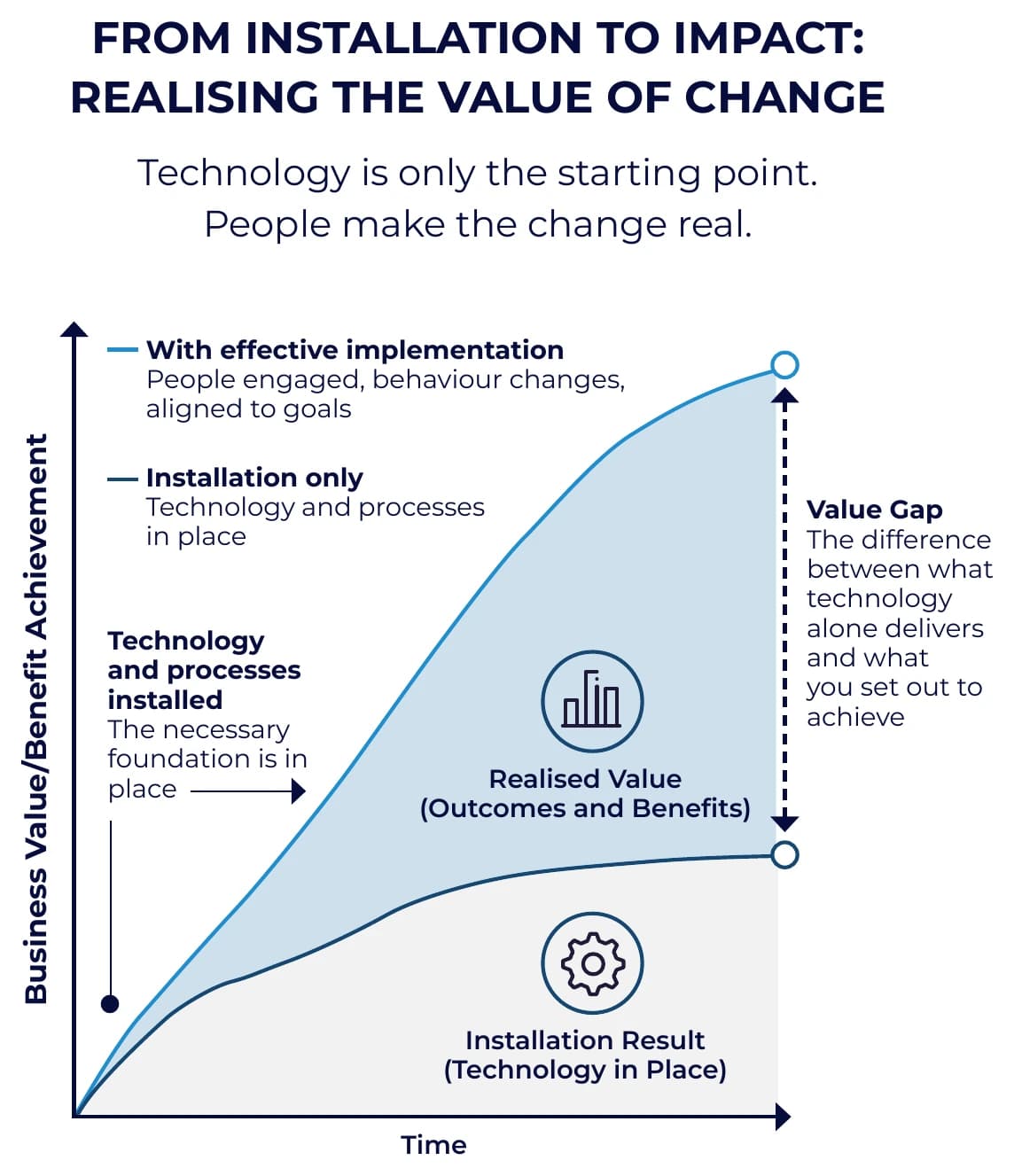
The period between technical deployment and the realisation of sustained operational value can be understood as the Value Gap.
During this period, organisations may have technically delivered the intended capability while operational benefits remain only partially realised. People are still developing competence and confidence, procedures are adapting, behaviours and working practices are evolving, and the organisation is learning how the capability performs under real operational conditions.
Closing the Value Gap is not solely a matter of adoption. Technology itself continues to evolve after deployment, as operational experience, user feedback and emerging needs drive further refinement and improvement. Technology, people and ways of working therefore need to evolve together throughout the operational lifecycle.
This reinforces the importance of measuring transformation success not simply through delivery milestones, but through operational outcomes. A capability should not be considered fully successful because it has been deployed on time or within budget; success depends on whether it is being used effectively and delivering sustained value in operation.
Figure 4 illustrates the Value Gap between technical deployment and sustained operational value, recognising that both operational adoption and continued evolution of the capability contribute to closing that gap.
Managing the Transition
The transition between current and future operating environments is itself a source of operational risk and complexity.
Legacy and future operating environments may coexist, different levels of automation may operate simultaneously, and operational roles, procedures and competencies continue to evolve. Organisations may therefore need to manage multiple configurations and ways of working over extended periods.
Managing this transition requires deliberate attention to sequencing, training, competence, workload, operational readiness and the cumulative impact of concurrent changes. Transition planning should therefore consider not only whether individual capabilities are ready for deployment, but whether the organisation and its people are ready to absorb and operate them safely.
Significant transition states should be explicitly assessed and managed, taking into account the specific risks, competency requirements, operating conditions and fallback arrangements that may arise while legacy and new systems coexist. Where appropriate, implementation plans should also establish clear criteria and decision authority for slowing, pausing or reverting a deployment if safety, operational readiness or organisational capacity requires it.
Delivering Sustainable Operational Value
Operational value is realised when new capabilities become embedded in everyday operations and contribute demonstrably to safer, more efficient or more resilient service delivery. A system may be delivered on time and to specification while still falling short of its intended value because adoption is incomplete, workload effects differ from assumptions or expected benefits do not materialise in practice.
Assessment should consider whether the intended safety, operational and human outcomes are being realised, drawing on evidence such as operational performance, usability and adoption, workforce experience and stakeholder confidence. As both the technology and its operational use evolve, benefits should continue to be tested against operational experience and adapted where outcomes differ from expectations.
Learning and Continuous Improvement
Every transformation generates knowledge that should strengthen the organisation’s ability to manage the next. Operational experience should be intentionally captured and translated into action, with learning extending beyond technical performance to include operational practice, human performance, training, governance and organisational behaviour. Where evidence indicates that assumptions were incorrect or intended outcomes are not being achieved, plans should be capable of changing accordingly.
Post-implementation review should therefore examine not only what was delivered and whether the expected benefits were realised, but also how effectively the organisation managed the transformation and what should be done differently next time.
3.4Cross-cutting Considerations for Future ATM Transformation
The transformation challenge will continue to evolve alongside the ATM system itself. Among the most significant developments are the increasing role of shared data ecosystems, advanced automation and artificial intelligence, which will change not only the technologies used in ATM, but also operational roles, decision-making and the nature of human-machine collaboration.
Data, Automation and Artificial Intelligence
ATM transformation is increasingly enabled by shared data ecosystems, advanced automation and AI-supported capabilities. These technologies have significant potential to improve safety, operational performance and predictability. Their value, however, will depend not simply on what the technology can do, but on how effectively it can be integrated into operational practice and trusted by those who rely on it.
As automation becomes more capable, human roles must evolve in parallel. The objective is not simply to transfer functions from people to technology, but to create partnerships in which their respective strengths complement one another. This requires clear allocation of roles and accountability, appropriate human involvement in safety-critical decisions, and sufficient understanding of system behaviour to support informed operational judgement.
Human competence must evolve alongside technological capability. Organisations will need to consider how automation affects skills, situational awareness, workload and the ability to intervene effectively under degraded or unfamiliar conditions. The question is therefore not only what can be automated, but what should be automated, under what conditions, and with what implications for the wider operational system.
Greater automation may also introduce new forms of complexity and dependency across data, software, cyber security, human–machine interaction and organisational boundaries. As systems become increasingly interconnected, failures or degraded performance in one area may propagate in ways that are difficult to anticipate. The appropriate form and level of human oversight should reflect the nature and criticality of the automated function, with proportionate explainability, clear responsibilities for intervention and the competence needed to manage degraded or fallback modes.
Looking Ahead
The future ATM system will continue to evolve, and so will the transformation challenges associated with it. New technologies, operational concepts and changing human roles will create opportunities that cannot yet be fully anticipated, together with new dependencies and forms of complexity.
The organisations best prepared for the future will not necessarily be those that transform fastest, but those that can transform continuously and sustainably while maintaining safety, operational effectiveness and trust.
Part 4
What this Means in Practice
The preceding sections have set out the principles and organisational capabilities needed to orchestrate transformation across a complex, safety-critical ATM system. This final section translates them into practical priorities for leaders across the ATM community.
It is not intended to prescribe a single change-management methodology or organisational model. Instead, it identifies areas requiring deliberate attention and provides questions that organisations can use to test current arrangements, identify gaps and determine where transformation capability may need to be strengthened.
4.1Treat Change Management as a Core Organisational Capability
The ability to orchestrate transformation is becoming as fundamental to future ATM performance as safety risk management, quality management and operational excellence.
This capability should be visible in how transformation is governed and managed: through clear ownership, portfolio-level oversight, active management of interdependencies and cumulative change load, realistic prioritisation, and feedback mechanisms that translate experience into decisions.
Warning signs that this capability may need strengthening include competing initiatives drawing on the same limited resources, growing change fatigue, limited visibility of cumulative workload, weak feedback loops, or success being measured primarily through delivery milestones rather than operational outcomes.
Questions to test your organisation
- 1Are governance structures, decision-making processes and coordination mechanisms enabling effective multidisciplinary collaboration, meaningful workforce participation and the constructive resolution of differing perspectives throughout the transformation lifecycle?
- 2Are lessons learned, operational experience, unintended consequences and improvement opportunities systematically captured, shared and used to inform subsequent decisions and implementation?
- 3Do your measures of success demonstrate that transformation is improving operational performance while maintaining safety, strengthening workforce trust and building the organisation’s capacity to manage further change?
- 4Are you managing the cumulative impact of multiple concurrent changes, or only monitoring the progress of individual projects?
- 5Are new capabilities being judged by successful deployment, or by the operational value they ultimately deliver?
4.2Keep Safety Foundational and Manage the Safety of the Transition Itself
Managing safety through transformation requires continuous assurance as risks evolve across different stages of the transition.
Some of the most significant risks may emerge not in the target state, but during the journey towards it, as legacy and new systems continue to interact (see Section 3.3). Established Safety Management Systems remain fundamental, and organisations also need the ability to anticipate emerging vulnerabilities, learn from operational experience and adapt as transition risks evolve.
Questions to test your organisation
- 1Does your safety management framework move beyond compliance to provide continuous assurance, enabling emerging risks to be anticipated, monitored and addressed throughout the transformation?
- 2Does your Safety Management System provide leaders with the safety intelligence needed to actively manage operational risk throughout the transformation lifecycle?
- 3Are you assessing and managing the safety of the transition itself, including the risks created by the coexistence and interaction of legacy and new systems, procedures, roles and levels of automation?
- 4Does your Safety Management System systematically incorporate intelligence from frontline reporting and operational experience to identify emerging risks, weak signals and unintended consequences?
- 5Is safety intelligence routinely influencing strategic, operational, workforce and investment decisions throughout the transformation?
4.3Put People at the Centre, and Co-design Change with Them
Applying Human-Centred Design principles, supported by meaningful co-design and sustained investment in learning, competence and organisational readiness, helps ensure that change reflects human capabilities and limitations as well as operational reality. When learning, understanding or organisational readiness consistently lag behind technological change, this is a signal to adapt and recalibrate the pace or approach.
Questions to test your organisation
- 1Are workforce reporting processes and feedback mechanisms accessible, trusted and responsive, and are they actively used to influence transformation decisions?
- 2Would affected employees describe the transformation as something being done with them rather than to them?
- 3Are you taking account of the reality of work as actually performed, rather than work as imagined or prescribed?
- 4Are human strengths, including judgement, adaptability, ethical reasoning and cross-domain collaboration, being designed into future systems and ways of working?
- 5Have Human Factors implications, including workload, situational awareness, human-machine interaction and effects on competence, been systematically assessed and addressed?
- 6Are people being given sufficient time, training and support to build confidence and competence before new capabilities are introduced?
4.4Build Trust and a Change-ready Culture
Trust and organisational culture shape how transformation is experienced, absorbed and sustained.
As set out in Section 2.3, trust is built through transparency, meaningful involvement and demonstrated experience. Organisations should also recognise that trust in people and institutions and trust in technology develop differently, and that both insufficient and excessive trust in automation can create risk.
Resistance and change fatigue should be treated as potential organisational signals rather than simply barriers to implementation. They may indicate unresolved concerns, insufficient readiness, competing demands or that the organisation’s capacity to absorb further change is being approached.
Questions to test your organisation
- 1Has senior leadership clearly communicated the purpose of the transformation, its expected outcomes, and the risks and trade-offs involved?
- 2Are progress, challenges and key decisions communicated openly and transparently throughout the transformation?
- 3Do workforce representatives and relevant multidisciplinary experts participate meaningfully throughout the design, testing, implementation and evaluation of the transformation?
- 4Does your organisational culture enable people to raise concerns, challenge assumptions and acknowledge mistakes without fear of inappropriate blame or consequences?
- 5Are you recognising and managing change fatigue before it begins to undermine engagement, operational performance or confidence in transformation?
Annex
Key Concepts and Definitions
This annex clarifies the terminology used throughout this paper to support a shared understanding of key concepts relating to ATM transformation. The definitions are intended to provide a common reference rather than prescribe formal meanings.
Note: The definitions presented in this Annex are adapted from internationally recognised standards, ICAO publications and established academic literature. They have been tailored to the context of ATM transformation and are intended to support a common understanding throughout this paper.
- Adaptation
- The ability of people and organisations to adjust behaviours, decisions and ways of working in response to changing operational conditions, new information and emerging challenges while maintaining safe and effective performance.
- Adoption
- The point at which a new capability, process or way of working is understood, trusted, routinely used and integrated into everyday operational practice.
- Change Fatigue
- A state in which individuals or organisations experience reduced capacity, motivation or confidence to absorb further change due to the cumulative effect of multiple concurrent initiatives, operational pressure, unclear priorities or insufficient recovery time.
- Change Management
- The structured approach through which organisations prepare for, implement, coordinate and sustain change across people, processes, technology and organisational structures. Within this paper, change management extends beyond individual project delivery and is treated as a core organisational capability for orchestrating multiple concurrent and interdependent changes.
- Change Resistance
- Concerns, hesitation or opposition that arise when individuals or groups perceive that change may create unresolved risks, loss of control, increased workload, reduced competence, unclear accountability or insufficient organisational readiness. In safety-critical environments, resistance may provide valuable insight into operational concerns and should be explored rather than dismissed.
- Co-design
- A collaborative approach in which the people affected by change, together with relevant multidisciplinary experts and stakeholders, actively contribute throughout the design, development, implementation and evaluation of change.
- Co-development
- The collaborative development and refinement of solutions through continuous engagement between all relevant stakeholders, ensuring that technical, operational, organisational and human perspectives evolve together.
- High Reliability Organisation (HRO)
- An organisation operating in a high-hazard environment that consistently sustains exceptionally low failure rates through strong operational discipline, continuous monitoring, collective mindfulness of emerging risk and the capacity to manage complexity under changing conditions.
- Human-Centred Design (HCD)
- An approach to the design and evolution of systems, services and ways of working that places human needs, capabilities and limitations at the centre of the process, informed by Human Factors principles and through iterative involvement of those affected throughout the lifecycle.
- Human Factors
- The discipline concerned with understanding the interactions between people, technology, tasks and organisations in order to optimise human performance, safety, wellbeing and overall system effectiveness.
- Operational Intelligence
- Insight derived from operational experience, data and day-to-day practice that supports understanding of how the system is performing and adapting in real-world conditions.
- Operational Readiness
- The degree to which people, processes, technology and governance are prepared for a specific change, at the point of its introduction.
- Organisational Readiness
- The broader, ongoing capacity of an organisation, its leadership, governance, competencies, culture and resources, to absorb, implement and sustain change in general, independent of any single initiative.
- Organisational Capability
- The collective ability of an organisation to consistently achieve its objectives through the effective integration of leadership, governance, culture, people, processes, knowledge and technology.
- Orchestrating Transformation
- The coordinated management of multiple concurrent and interdependent changes across a complex socio-technical system, ensuring that strategy, governance, safety, people, technology and operations evolve together while maintaining operational continuity.
- Psychological Safety
- A working environment in which people feel able to raise concerns, ask questions, challenge assumptions and report mistakes without fear of inappropriate blame or negative consequences.
- Resilience
- The ability of a socio-technical system to anticipate, absorb, adapt to and recover from disruptions while continuing to deliver safe and effective operational performance.
- Safety Intelligence
- The timely collection, integration, interpretation and use of safety-related information from operational data, reporting systems, operational experience and other sources to support informed decision-making and proactive risk management.
- Socio-technical System
- A system in which people, technology, operational processes, organisations, governance arrangements and the external environment continuously interact and influence one another.
- Systems Thinking
- An approach that considers the relationships, interactions and interdependencies between different parts of a system, recognising that overall behaviour emerges from these interactions rather than from individual components in isolation.
- Transformation
- A sustained organisational evolution involving coordinated changes to people, technology, operations, governance and culture that collectively reshape how an organisation delivers value and achieves its strategic objectives.
- Transition State
- An intermediate stage in the transformation journey during which legacy and future operating environments coexist. Transition states often introduce additional operational complexity and require deliberate management to maintain safety, resilience and service continuity.
- Trust
- Confidence in people, organisations or technology based on demonstrated reliability, transparency, competence and experience. In relation to automation, trust should be appropriately calibrated to the system’s capabilities and limitations, avoiding both insufficient and excessive reliance.
- Work as Imagined
- How work is expected or intended to be performed, as described in procedures, plans, regulations or system designs.
- Work as Done
- How work is actually performed under real operational conditions, reflecting adaptation, variability, operational judgement and experience.
Acknowledgements
Who produced this paper
Convenors
- Global ATC Alliance
- Civil Air Navigation Services Organisation (CANSO)
Partner organisations
- International Federation of Air Traffic Controllers’ Associations (IFATCA)
- International Federation of Air Traffic Safety Electronics Associations (IFATSEA)
- International Federation of Aeronautical Information Management Associations (IFAIMA)
Paper Development Team
Chair
Ben Stanley
CEO, Firstfruits Services (CANSO)
Contributors (alphabetical)
Frank Kofi Apeagyei
President (IFATSEA)
Tatjana Bolić
Senior Research Fellow, University of Westminster; Chairperson of the SESAR 3 Joint Undertaking Scientific Committee (Independent Adviser)
Nick Daniels
NATCA President (Global ATC Alliance)
Barbara Fröhlich
Executive Secretary (IFAIMA)
Trish Gilbert
Executive Vice President Professional (IFATCA)
Howard Greaves
Deputy Director General, Jamaica Civil Aviation Authority (CANSO)
Nicki Harricharan
Operations Programme Manager (CANSO)
Parimal Kopardekar
Director, Airspace Operations and Safety Program, NASA (Independent Adviser)
Coral McLaren
ANS Special Projects Office, Jamaica Civil Aviation Authority (CANSO)
Coral Perry
Operations Change Manager, NATS (CANSO)
Kim Pyle
Oliver Wyman Vector and Former FAA Executive Director, Accident Investigation and Prevention (Independent Adviser)
Helena Sjöström Falk
President (IFATCA)
Nick von Schoenberg
CATCA President (Global ATC Alliance)
Dan Walker
Operational ATCO, CATCA (Global ATC Alliance)
Randy Willis
Senior Policy Advisor, Northrop Grumman (CANSO)
Secretary
Eduardo Garcia
Senior Manager Future Skies (CANSO)
Cite this paper
CANSO et al. (2026), Orchestrating Transformation in Our Skies: Co-designing Change through a People-Centred Framework. DOI: 10.5281/zenodo.22273833.
© CANSO 2026. This publication is licensed under a Creative Commons Attribution 4.0 International (CC BY 4.0) licence. It may be shared and adapted for any purpose, provided appropriate credit is given, a link to the licence is provided, and any changes made are indicated.
This publication is provided for information purposes only. While every effort has been made to assure the quality and accuracy of the information contained herein, it is made available without any warranty of any kind.
Part of the Future Skies programme: www.futureskyvision.com