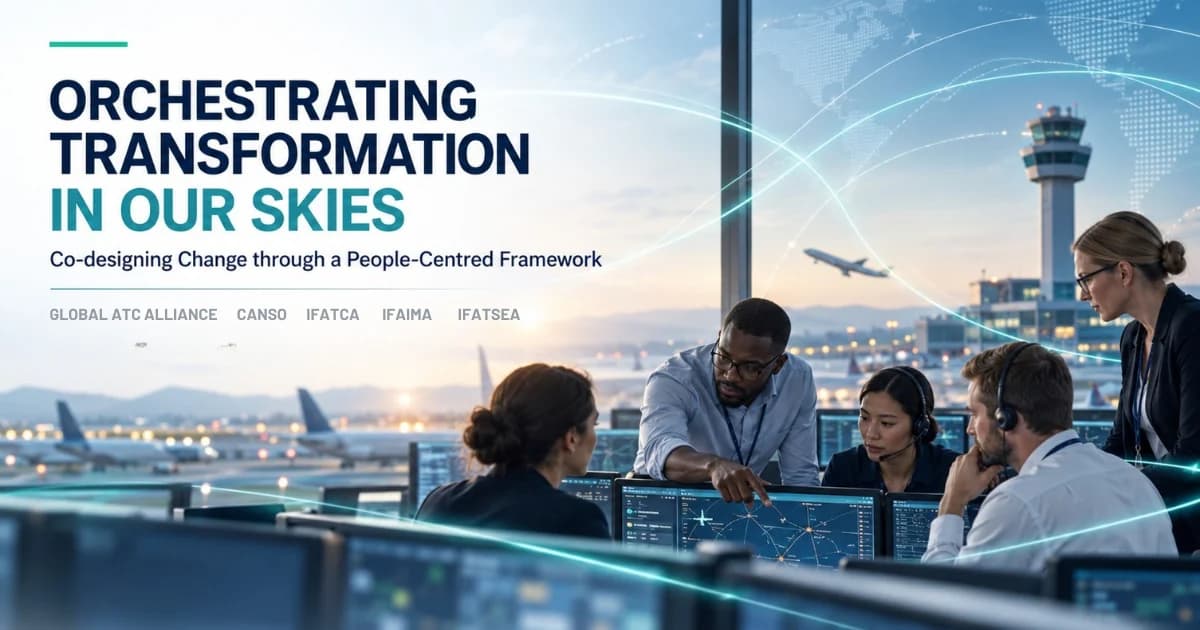
Five leading organisations from across the global air traffic management (ATM) community have joined forces to publish a new white paper challenging the sector to rethink how it manages transformation.
Orchestrating Transformation in Our Skies – Co-designing Change through a People-Centred Framework was convened by the Global ATC Alliance and the Civil Air Navigation Services Organisation (CANSO), with the active participation of the International Federation of Air Traffic Controllers’ Associations (IFATCA), the International Federation of Air Traffic Safety Electronics Associations (IFATSEA) and the International Federation of Aeronautical Information Management Associations (IFAIMA), supported by academic and independent experts.
ATM is not simply going through another cycle of technology upgrades. It is entering a period of continuous, interconnected transformation in which changes to technology, operations, people and organisations increasingly interact.
Digitalisation, automation and artificial intelligence are changing how services are delivered, how decisions are made and how people work. At the same time, growing system interdependencies mean that a change introduced in one part of the system can create consequences somewhere entirely different.
The paper therefore asks a simple but increasingly urgent question:
How can the ATM community orchestrate this transformation safely, coherently and successfully?
Its central argument is that transformation can no longer be managed simply as a collection of individual projects. In a system as interconnected as ATM, every change ripples. An organisation can have individual projects performing well while cumulative change, competing demands and hidden dependencies place the wider system, workforce or organisation under increasing pressure.
The ability to orchestrate transformation must therefore become a core organisational capability: bringing strategy, governance, safety, technology, people and operational reality together, while actively managing interdependencies, priorities, organisational capacity and the pace of change.
The paper also challenges some traditional assumptions about transformation.
It argues that safety is not the brake on transformation, but the engine that gives organisations the confidence to move. And some of the greatest risks may lie not in the future system itself, but in the journey towards it, as legacy and future systems coexist, different levels of automation operate side by side, and people move between different procedures, technologies and ways of working.
It also argues that automation does not remove complexity, it often redistributes it. As technology becomes more capable, human judgement, adaptability, contextual understanding and accountability remain fundamental. People should therefore not be treated simply as recipients of transformation, but as active co-designers of it, bringing operational experience into decisions from the outset.
The paper further encourages leaders to look differently at apparent resistance to change. In a safety-critical environment, resistance may be a signal rather than an obstacle, revealing unresolved safety concerns, workload pressures, insufficient readiness, unclear accountability or an organisation approaching the limits of its capacity to absorb further change.
And it makes another important distinction: deployment is not the finish line.
A new capability should not be considered successful simply because it has been installed, delivered on schedule or brought into service. Transformation creates value only when that capability is safely adopted, routinely used and delivering its intended operational outcomes.
The white paper does not prescribe a single change-management methodology or organisational model. Instead, it provides a practical, people-centred framework that organisations can adapt to their own circumstances, helping leaders test whether they have the governance, organisational readiness, safety intelligence, workforce involvement and capacity needed to manage continuous transformation successfully.
The five organisations behind the paper emphasise that the transformation ahead cannot be delivered by any single organisation, profession or part of the aviation ecosystem acting alone. It requires collaboration across traditional boundaries and shared responsibility for how change is designed, introduced, adopted and sustained.
As the paper concludes:
“The future of ATM will be shaped as much by how we transform as by what we transform.”
The White Paper
Orchestrating Transformation in Our Skies
Co-designing Change through a People-Centred Framework